In this Nanobébé Flexy review, I'm going to treat the bottle like test equipment and ask a blunt question: does it actually function as the best bottle for breastfed infant feeding, or is it just another cute silicone bottle in your sink? We'll break down design, latch, flow, venting, compatibility, and cost-per-feed so you can decide with data, not marketing.
The Problem: Breastfed Babies + Bottles = High-Stakes Guesswork
If you're reading this, you're probably staring down at least one of these problems:
- A baby who happily nurses but refuses every bottle you try.
- A return-to-work date or daycare start looming, with no reliable bottle yet.
- Nipples labeled "newborn" or "slow flow" that pour like a faucet or barely drip.
- Baby coughing, sputtering, or arching because the flow is wrong.
- Nipple collapse or vacuum lock halfway through a feed.
- Leaks in the diaper bag because one ring wasn't tightened just right.
- Colic/reflux worries and endless vent pieces to scrub.
- A cabinet full of "almost right" bottles and a sense of sunk-cost guilt.
You're not looking for another bottle to "try." You're looking for a short list, with a clear, low-risk way to test and standardize a setup that works.
That's where a structured look at the Nanobébé Flexy can help. If you're worried about introducing bottles without derailing nursing, see our step-by-step transition guide.
Why This Choice Feels So Hard (Agitate)
The bottle aisle looks huge, but under the surface there are three real constraints:
-
Latch and flow must match your baby, not the label.
"Level 1" on one brand can behave like "Level 2" in another. There's no universal standard, so two "newborn" nipples can have dramatically different flows.
-
Venting and seal quality directly affect stress levels.
Poor venting = extra air, more gas, and babies popping off frustrated. Overly complex vent systems = more ways to misassemble and leak. You're tired; minor design flaws become major problems at 3 a.m.
-
Your existing gear ecosystem matters.
Pumps, warmers, sterilizers, daycare rules, and how many caregivers are involved all affect what "best" looks like. A perfect bottle that doesn't fit your warmer or daycare workflow is not actually a good solution.
On top of that, most parents are making decisions under time pressure. There's a work deadline, a NICU discharge, or a growth spurt happening right now. You don't have a month to run uncontrolled experiments with five bottle systems.
What you need is a way to:
- Understand what Nanobébé Flexy is designed to do.
- See how it compares to other top contenders.
- Run your own simple, standardized tests (latch and flow) before you commit.
The Nanobébé Flexy Under the Microscope
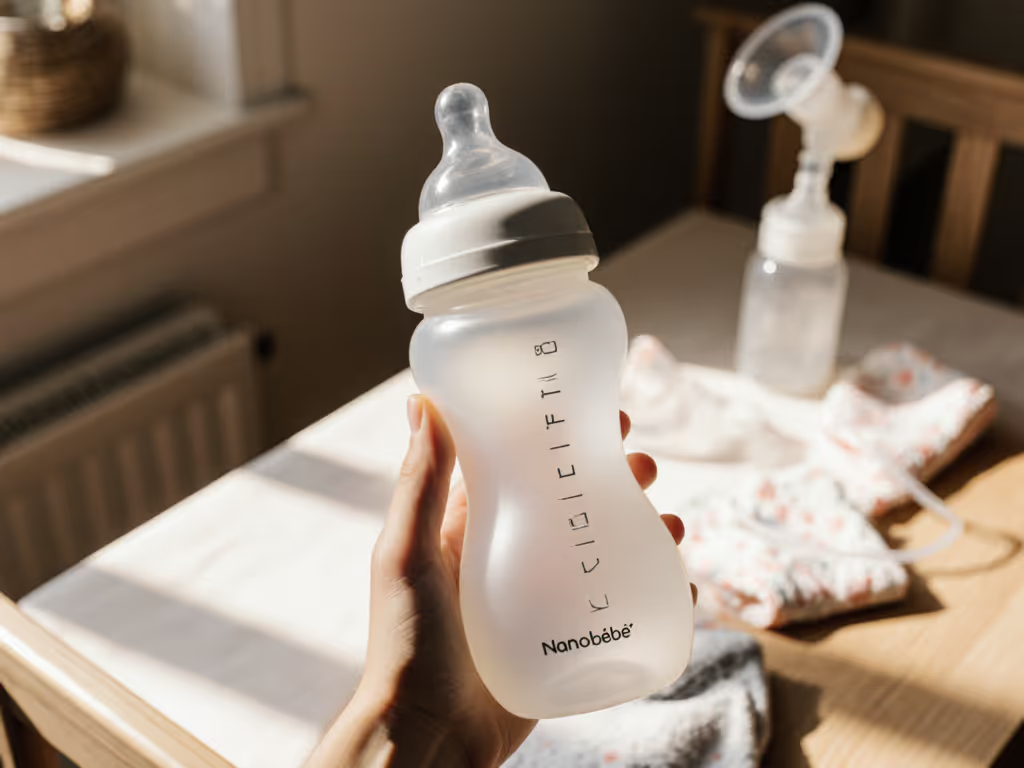
The Nanobébé Flexy is a breast-shaped silicone bottle designed as a one-system solution from newborn through toddler. Unlike Nanobébé's original "breastmilk" bottle (the shallow, saucer-shaped one), the Flexy looks more like a conventional bottle, just softer and more contoured.
Core Design and Materials
Key components:
- Flexy silicone bottle body (soft, slightly grippy, wide base)
- Flexy silicone nipple (multiple flow levels: typically newborn/slow, medium, fast)
- Plastic screw ring that holds the nipple in place
- Cap/cover for storage and transport
Material claims from the manufacturer:
- Bottle and nipple: food-grade silicone
- Plastic parts: BPA-, phthalate-, and lead-free, per Nanobébé's FAQ
What this means practically:
- You avoid the brittleness and potential micro-cracking of some hard plastics.
- The bottle is lightweight and shatterproof, important for daycare and travel.
- Silicone tolerates repeated sterilizing and dishwashing without warping as easily as some plastics.
The body is intentionally wide with a low center of gravity. On a countertop, these are among the hardest bottles to tip over in their size class. That matters when milk is measured in minutes of pumping.
Latch Transition Effectiveness
Nanobébé markets the Flexy nipple as mimicking breastfeeding and supporting latch transition. They don't use the exact phrase "breastmilk simulation technology" for this bottle in the same way they do with their original breastmilk bottle design, but the core idea is similar: shape and resistance that feel familiar to a nursing baby.
Design features that influence latch:
- Wide, breast-shaped base: gives the lips a broad flange.
- Gradual slope (not a sharp ledge) from the base to the tip: supports a deeper latch rather than a shallow "tip-only" latch.
- Soft, compressible silicone: allows baby to control flow a bit more with jaw and tongue, closer to breast mechanics.
In real-world use (pulling from caregiver reports and IBCLC feedback):
- Babies who already nurse with a deeper latch often do well on Flexy because the geometry encourages similar mouth positioning.
- Babies used to narrow-neck, straight nipples sometimes need a short adjustment period.
The main advantage: the Flexy nipple tends to discourage a lazy, shallow latch, which can protect some breastfeeding relationships from "bottle-only" preference.
Venting and Anti-Colic System
The Flexy nipple uses a built-in vent system (small valve near the base of the nipple) rather than a separate straw or disc.
What this system aims to do:
- Allow air into the bottle as milk leaves, preventing vacuum lock and nipple collapse.
- Reduce how much extra air baby swallows by keeping the nipple steadily full.
Compared to something like Dr. Brown's Options+ (with an internal vent tube): For a deeper dive into how different venting systems stack up, see our anti-colic bottle comparison.
- Fewer parts: just the nipple, ring, bottle, cap.
- Less risk of assembling a vent incorrectly.
- Slightly less aggressive air removal; for severe reflux/colic cases, some families still prefer dedicated vent tube systems.
In practice, when the vent is working and the nipple isn't blocked:
- Nipple collapse is rare.
- Feeds stay consistent across the session, which helps babies maintain rhythm.
Flow Options and Real-World Behavior
This is where labeling often breaks down across brands, so I focus less on the words ("Newborn," "Stage 1," etc.) and more on behavior plus testing. For why labels vary and how to choose confidently, read our lab-tested flow rate guide.
What's available for the Flexy:
- Typically: Newborn/Slow Flow, Medium Flow, Fast Flow (naming can vary slightly by region).
- Many families start breastfed babies on the slowest Flexy nipple and stay there longer than packaging suggests.
What parents report in terms of latch transition effectiveness:
- Flexy slow flow usually behaves like a true slow flow - not a hidden medium flow. Babies who are used to the breast's slower, variable flow often tolerate it better than some "level 1" nipples from other brands.
- For babies with stronger suck or older infants, moving to the next flow level can be smooth, but you'll want to test each step (more on Nanobébé flow rate testing below).
Cleanability and Mold Risk
This is a strong point for the Flexy:
- Only 3-4 main parts per bottle (body, nipple, ring, cap).
- Wide mouth: you can easily get a standard bottle brush or even your hand inside.
- No hidden straw, no discs, no separate vent caps.
- Dishwasher safe (top rack is typical; always double-check your specific packaging). For complete sanitation routines across materials, see our bottle cleaning and sterilization guide.
For families burnt out on multi-part vent systems, the Flexy's simplicity significantly lowers the assembly error and mold risk.
Measurement Accuracy and Intake Tracking
The Flexy has printed measurement markings on the silicone body. Two practical notes:
- Because silicone is flexible, the bottle can bulge slightly if squeezed, skewing the visible line. For accurate measurement, hold the bottle upright and avoid squeezing when reading.
- For precise intake tracking (pumped volumes, NICU/preemie needs), I recommend doing your initial measurements in a more rigid container or on a scale, then pouring into the Flexy.
Once you know the lines are reasonably accurate when the bottle is relaxed, they're fine for day-to-day home use.
Head-to-Head: Nanobébé Flexy vs Other Popular Bottles
Below is a high-level comparison with three other common choices for breastfed babies: Comotomo (another breast-shaped silicone bottle), Philips Avent Natural, and Dr. Brown's Options+.
Quick Comparison Table
| Feature | Nanobébé Flexy | Comotomo Silicone | Philips Avent Natural | Dr. Brown's Options+ |
|---|
| Nipple style | Wide, breast-shaped, gradual slope | Wide, dome-shaped | Wide, but more pronounced ledge | Narrower, traditional shape |
| Material | Silicone body & nipple, plastic ring/cap | Silicone body & nipple | Hard plastic bottle, silicone nipple | Hard plastic bottle, silicone nipple |
| Venting | Built-in nipple vent | Dual anti-colic vents | Airflex vent in nipple | Internal vent tube system |
| Parts per bottle | 3-4 | 3-4 | 3-4 | 5-7 depending on vent use |
| Cleanability | Easy | Easy | Easy-moderate | Moderate-hard |
| Latch support for breastfed babies | Strong | Strong | Moderate-strong | Moderate |
| Flow label accuracy vs behavior | Generally true-slow on slow flow | Often moderate (slightly faster) | Varies by line | Varies; slow can be quite slow |
| Leak risk when assembled correctly | Low | Low-moderate (squeeze risk) | Low | Low-moderate (if vent misaligned) |
Where Nanobébé Flexy stands out:
- Stability: very hard to tip over compared to Comotomo's taller design.
- Latch geometry: less "domed" than Comotomo, more like a breast stretched into baby's mouth.
- Parts vs performance: you get anti-colic venting without extra vent tubes.
Where alternatives might win for some families:
- Severe reflux/colic: Dr. Brown's internal vent can be more effective for some babies, at the expense of more parts.
- Exact volume tracking: hard plastic bottles like Avent Natural give more precise, non-flexing measurement lines.
- Pump-direct feeding: some plastic bottles screw directly onto certain pump flanges; the Flexy generally doesn't, so you'll likely pump into other containers and then pour.
So, is Flexy "the best"? For many breastfed babies, it's absolutely in the top tier, but the real answer depends on your baby's latch and your gear ecosystem.
Flow Rate and Latch Testing (Including Nanobébé Flow Rate Testing)
Labels don't feed babies. Flow and fit do.
Here's how to run a simple, repeatable test on any nipple, including the Nanobébé Flexy, without lab equipment.
The goal is to standardize your testing so you can compare nipples across brands, not just guess by "feel."
Step 1: Visual Latch Check (Dry Run)
Before you ever pour milk:
- Offer the empty Flexy nipple at baby's mouth.
- Watch for lips flanged wide, not tucked in.
- Check that a good portion of the nipple base (not just the tip) is inside the mouth.
- Reject setup if baby can only latch shallowly on the tip despite your positioning.
If latch looks deeper and similar to breast, Flexy passes the geometry test.
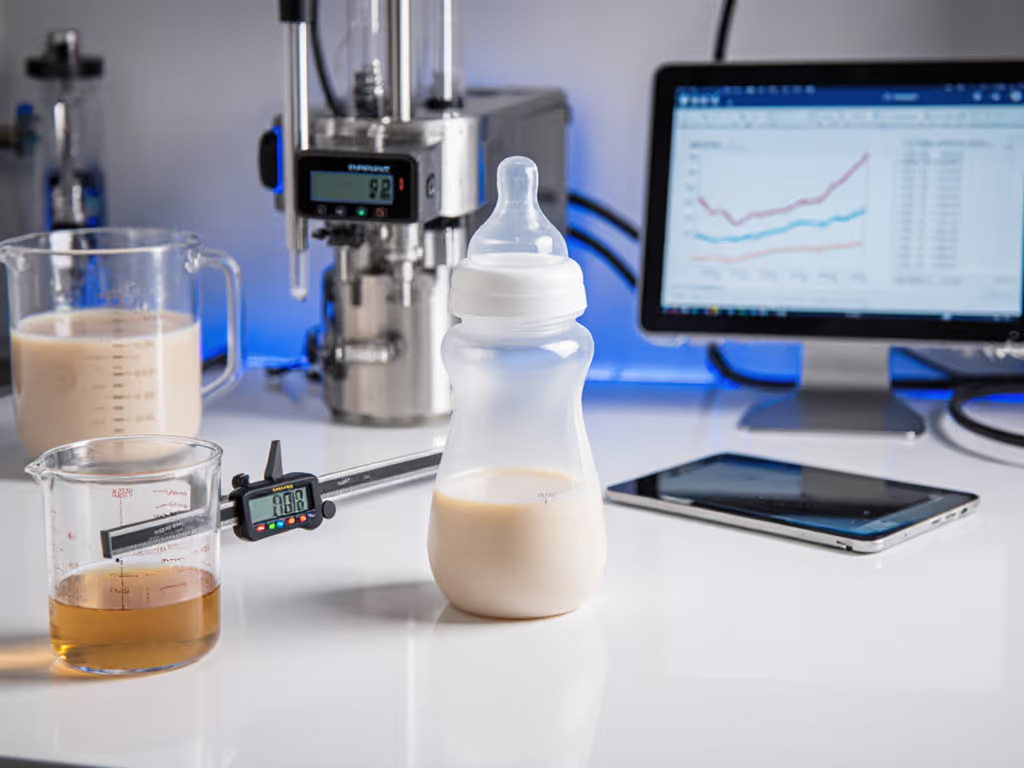
Step 2: Nanobébé Flow Rate Testing With Water
You can quantify relative flow using plain water, a kitchen scale, and a timer (the same quick hack I used once when I was down to a single clean bottle and needed to stop a leak without buying a new system).
- Fill test: Fill the Flexy with a set volume of water (e.g., 60 mL / 2 oz).
- Weigh the filled bottle on a digital kitchen scale and note the starting weight.
- Hold the bottle at the angle you'd normally feed, with the nipple pointing down, and let it drip freely into a bowl without squeezing.
- Start a timer for 60 seconds.
- After 60 seconds, weigh the bottle again. The difference in weight (in grams) ~ mL of water that flowed out.
Repeat this with:
- Flexy slow-flow nipple
- Any other slow-flow nipples you own
You now have comparable numbers. If the Flexy slow flow releases significantly less water in 60 seconds than another brand's "newborn" nipple, you've confirmed that Flexy is a slower, more breastfeeding-like flow for your baby.
Step 3: Real Feed Observation
During an actual feed:
Watch for signs the flow is too fast:
- Coughing or sputtering in the first minute.
- Milk spilling from the sides of the mouth.
- Very short feeds with lots of spit-up afterward.
Signs the flow may be too slow:
- Baby sucking hard but falling asleep repeatedly before taking a reasonable volume.
- Feeds stretching to 40-60 minutes routinely.
- Persistent frustration at the bottle despite good latch.
Combine your latch observation, water test, and baby cues to decide whether to stay on the current Flexy flow or move up one level.
Real-World Use Cases: When the Flexy Shines (and When It Doesn't)
Strong Fit
Nanobébé Flexy is often an excellent choice if:
- You have a baby who nurses well but has rejected stiffer, narrow nipples.
- You want a breast-shaped silicone bottle that supports deep latch without a ton of parts.
- You've had issues with nipple collapse or vacuum lock on other brands.
- You're trying to standardize for multiple caregivers and need something easy to assemble correctly every time.
- You prioritize shatterproof, lightweight bottles for daycare or travel.
Possible Mismatch
Flexy might not be your best primary system if:
- Your baby has complex reflux or severe gas issues and has done dramatically better on a specialty vent system like Dr. Brown's.
- You rely on pumping directly into bottles to avoid transfers; the Flexy usually requires pouring from storage bottles or bags.
- Your warmer only fits tall, narrow bottles; always test with water first. Many open-bath warmers are fine, but some narrow-sleeve warmers won't accommodate the wider Flexy base.
- You need ultra-precise intake tracking for medical reasons and prefer rigid, exact measurement containers.
In those cases, Flexy may still be a secondary or occasional bottle, but not your main system.
Cost, Durability, and Reuse Pathways
I look at bottles in terms of cost per successful feed, not just sticker price.
Rough Cost-Per-Feed Math
Pricing varies by region and retailer, but as a ballpark, a 3-pack of Nanobébé Flexy bottles is often in the US$20-$30 range at major retailers (check current pricing).
Assume:
- You use 3 bottles in rotation for 9 months (from 3-12 months of age).
- Baby takes an average of 5 bottle feeds per day (full-time bottle feeding, or combined daycare + home).
- That's 5 feeds × ~270 days ≈ 1350 feeds total across the set.
$25 ÷ 1350 feeds ≈ 2 cents per feed for the bottles themselves, excluding nipples.
Add a couple of extra nipple sizes over the year and you might add another $10-$15 total. You're still in low single-digit cents per feed as long as you:
- Pick the right system early, and
- Avoid buying three or four competing systems that don't get used.
This is where strategy matters. Use what you own; spend where outcomes genuinely improve. If you already have a bottle that your baby takes well, Flexy has to offer better latch, less gas, easier cleaning, or fewer leaks to justify the switch.
Reuse First: Smart Ways to Integrate Flexy
If you're considering Nanobébé Flexy, I recommend this minimal-risk pathway:
- Audit what you already have.
- Do you own any wide-neck systems that are "almost right" except for one specific issue (flow, collapse, or cleaning)?
- Identify what exactly is failing.
- Buy a small test set, not a full system.
- 2-3 Flexy bottles with slow-flow nipples are enough to test latch, flow, and leaks over a week.
- Don't buy a 10-bottle daycare set until you've run your own tests.
- Keep working bottles in rotation.
- If you have another brand that your baby already accepts, run side-by-side testing rather than replacing everything overnight.
- Use the weaker system as backup, travel, or for mixing medicine/fortifier if recommended by your clinician.
- Standardize once acceptance is proven.
- When Flexy clearly wins (better feeds, fewer leaks, easier nights), then duplicate that setup for daycare and grandparents.
Step-by-Step: Actionable Next Steps With Nanobébé Flexy
1. Map Your Current Setup
Write down:
- Current bottle(s) and nipple flow levels in use.
- Known problems (refusal, leaks, gas, cleaning headaches).
- Gear constraints: pump type, warmer model, daycare rules (pre-assembled only? labels on caps?).
2. Decide If Flexy Solves a Real Problem
Flexy is worth testing if you check yes on any of these:
- "My baby collapses nipples or fights vacuum lock."
- "We want a softer, breast-like nipple to protect breastfeeding."
- "I'm done with multi-piece vent systems that hide mold."
- "We need a tip-resistant, shatterproof bottle for daycare."
If none apply and your current bottle works, your best move might be to not switch and simply optimize nipples and flows.
3. Run a One-Week Flexy Trial
- Buy 2-3 Flexy bottles with slow-flow nipples.
- Test them with water in your existing warmer and diaper bag to check fit and leaks. If you use a warmer, check our bottle warmer compatibility guide to confirm fit and heat consistency.
- Introduce one Flexy feed per day at a calm time (ideally, someone other than the nursing parent offers the bottle).
- Use the flow and latch testing method above to confirm you're on the right nipple level.
Track (even just in your notes app):
- How long each feed takes.
- Baby's behavior (calm, frustrated, gassy afterward).
- Any leaks or assembly issues.
4. Standardize or Pivot
After 5-7 days of consistent testing:
- If Flexy feeds are clearly smoother (better latch, fewer gas episodes, less mess), that's your signal to:
- Buy enough Flexy bottles to cover 24 hours plus one extra full set for daycare.
- Standardize nipple flow and label bottles for caregivers.
- If results are mixed, keep Flexy as a tool in your kit and don't expand yet.
- If Flexy underperforms your existing system, you've learned something valuable without committing to a full switch.
Bottom Line: Is Nanobébé Flexy the Best Bottle for Your Breastfed Infant?
For many families, Nanobébé Flexy sits in the short list of top options for breastfed infants:
Strong Pros:
- Breast-shaped silicone nipple that supports deep latch.
- Built-in venting without extra parts, reducing collapse and leaks.
- Stable, tip-resistant base and shatterproof body.
- Simple cleaning and low mold risk.
- Flow options that tend to behave like true slow-to-medium flows when tested.
Watchpoints:
- Not ideal for direct pump-to-bottle setups.
- Wide silicone body may be incompatible with some narrow warmers.
- Flexible walls make ultra-precise measurement slightly less convenient.
If your main goals are protecting breastfeeding, reducing gas/leaks, and minimizing parts, Nanobébé Flexy is a serious contender for "best bottle" in that context. The final decision should come from your own standardized tests and your baby's response, not anyone's favorite-brand list.
Your next step: decide whether Flexy solves a specific problem you have today. If it does, run a small, controlled trial using the testing framework above. If it doesn't, refine what you already own instead of starting over with a new system.
Use what you own; spend where outcomes genuinely improve.